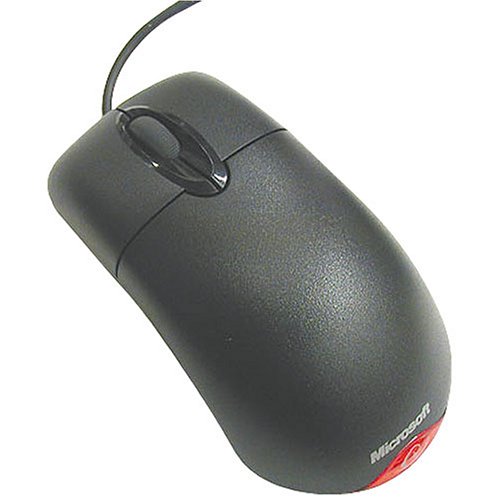
The Optical Mouse

When the original optical mouse was developed, two independent inventors created their own versions. The first was created by Steve Kirsch of MIT. He was able to track the movement of the mouse by using an infrared LED along with algorithms performed by the CPU to calculate the speed and direction of the mouse based on grid lines printed with infrared absorbing ink on a special metallic surface
.
Another version was developed by Richard F. Lyon. In his version on the optical mouse, he used a 16-pixel visible-light image sensor with integrated motion detection on the same chip
. He was able to track the movement of the mouse by detecting a grid of light dots on specialized paper on mouse pad.
Unlike early optical mice that track printed grids that work only on specific surfaces, modern optical mice use a sensor that works basically as a low resolution video camera that tracks the movement on most any surface. The first optical mouse as we know it was the Microsoft IntelliMouse line of mice. These mice worked on most surfaces with a much better accuracy and sensitivity than mechanical mice.
Laser mice are very similar to the way modern optical mice work. However, instead of using a LED to create light below the mouse sensor, laser mice use an infrared laser diode to create the light under the mouse. Laser mice began mass production in 2004 with the launch of Logitech's MX1000 laser mouse. With the implementation of laser sensors, this allowed mice to track 20 times more surface than traditional optical mice.
This page last modified on: February 8, 2013